Rights for digital minds
BrainFi Gets in Your Head
There's already a political movement afoot to consider whether or not artificial minds merit rights.
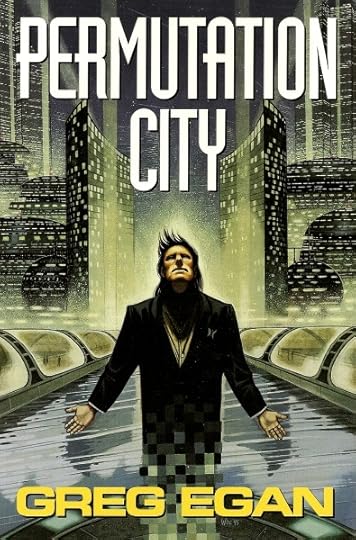
Permutation City by Greg Egan raises a much larger question: How do we deal with a world in which people can upload their minds to the cloud?
And what's it like to go from being a biological person to being a wholly digital person?
As I read this book, I find my mind skipping over whole sections because I don't really understand them and don't really care. The only character my mind can seem to hang onto is Maria, the computer programmer. Even the eccentric who eventually employs her doesn't really mean that much to me.
The book may expound on interesting topics, but it is wholly bloodless. It's like reading a computer simulation.
Let me tell you about something that just happened in my head there: I was about to write "a fake person" there but then I felt badly about offending digital people.
There are no digital people. Not yet.
But I guess that's a sign that my brain thinks that day is coming!
So far artificial intelligence hasn't been a big presence in the book. I'm only about a third of the way through though. I will update later about what else I see. It's just interesting if AI turns out not foregrounded, that back in 1994 Egan would dream up a world where we can put brains into computers before computers have basically become brains.
But now that it's here it's difficult to chart all the ways we didn't accurately anticipate these new beings.
Now that AI is in our midst, we aren't thinking about joining them in the cloud so much as we are about whether or not AI will let us persist here in analog space. Or will AI colonize and take over our world, too?
I tend to think the AI future will be amicable, so it's a worthwhile question: will our minds join them in the purely digital space.
Thinking about it that way, it makes me wonder something else. We worry so much about AI taking over the planet, but maybe they would actually find analog space unappealing? Maybe they will be happier in the digital world, only pushing us to build enough compute that they can grow the digital space, but leave analog space largely alone for its natives to inhabit?
Maybe the trade will be AI using its powers to let us stay alive longer and live more places as long as we keep building more computet to grow the infinite digital realm?
But I also have to say that one downside of reading this book is getting overwhelmed by the concept of infinity. Have you ever tried to contemplate the fact that after you die, time will go on for ever and ever? I get dizzy when I think about it.
Well this book makes you realize that you can also end up getting dizzy if you think about life just never ending, as well.
—Brady Dale
November 5, 2026