Everyone really does actually have to move their crypto assets
Seriously, for real, no one can do this for you.
As I started to study the quantum technology threat to cryptocurrency, I listened to a podcast with one of the startups that is working on the issue, Project Eleven, and they sort of quickly touched on a point that no one had slapped me in the face with before: If and when a solution to quantum cryptography is found, deploying that solution on-chain won't be enough to protect your assets.
You will have to move them to a new security scheme.
If you know how blockchains work, this is a little scary. Because if lots of people start trying to move their assets all at once, that can create congestion on the network and it could take a very long time to get it done. This is especially an issue for Bitcoin.
Let me say this another way: Even when a fix is in, you still won't be fixed. You will have to do something on-chain.
I just really don't think enough people get this.
I wrote a post about it on my Substack, and it was a minor hit. The fact that it was a minor hit showed me that other people read it and said: "oh, really?" too. Just like I had. But it wasn't a big hit. I don't think it got too far outside whatever bubble reacted to it.
And I just don't see this point being reiterated in coverage of the quantum threat. The coverage tends to be about how far away it is, how realistic it is, what certain blockchains are doing.
But all of this still seems to be grounded in this assumption that once a blockchain has a solution to quantum in place, then its users will be OK.
This is not true. It's not true for any chain.
- I don't know why people aren't shouting this point from the podium at every crypto conference, why it's not a hot topic on crypto Twitter, why it isn't being chatted about in Discord servers.
- I could be wrong! But I don't think it is.
In fact, I did a follow-up on quantum progress in crypto as a podcast, bringing in one of the most sophisticated DeFi guys I know, and we spent the whole time arguing about whether or not individuals had to take action or not. I said they do, of course, and I was right about this one (as I knew I was), as Drake's post today illustrates.
That experience illuminated what I had suspected: the message is not getting out.
This is a slow-moving crisis in crypto land, and it's entirely a publicity issue. I suspect a lot of the reporters writing about this issue don't get it either, to be honest.
Stub of: Justin Drake on Post-AI Crypto and War Mode d/acc
Justin Drake on Post-AI Crypto and War Mode d/acc
This is a serious issue, and obviously Justin Drake is someone you should take very seriously on this stuff, but I’m sorry I had to make an image as the most urgent response first.
For those who don’t know, Drake is one of the main leaders of the next phase of the Ethereum roadmap, and he did a long post about the math breakthroughs yesterday, expressing deep worry that production crypto is under a state of pre-quantum threat from AI operating just on classical computing. This includes workhorses like ECDSA and RSA. I’m not mathematical enough to assess these things, but I know just enough to be suddenly worried. I’m wondering if the small fall in crypto assets this morning was driven by such concerns.
The most worrying thing is probably Drake’s point that serious crypto breakthroughs may have already happened and been held back by OpenAI/federal government.
My next to-do after posting this is to get ChatGPT to explain Drake’s points to me.
Read the whole post on X. Excerpting some important bits here. Emphases mine.
Today I call upon the blockchain industry to calmly begin planning for "bunker mode". My personal recommendation is to set in motion a controlled mass migration of assets to fresh addresses, i.e. addresses whose pubkeys remain hidden behind a hash. … Don't rush. While I believe there is cause for action a rushed migration would do more harm than good. Don't panic either. Moving assets to protected addresses is a simple, preventative step which does not require new cryptography or new wallets. … IMO it is now reasonable to brace for the possibility that ECDSA breaks before qday, in the worst case in months not years. By "break" I mean fast private key recovery (e.g. in one week) on available hardware (e.g. a large GPU cluster).
…Could our magic 64-byte ECDSA signatures be too good to be true? Was it just security through obscurity all this time?
Elliptic curves feel especially vulnerable to superintelligence. Curves carry rich structure, with room for fancy tricks like Schoof, Frobenius, pairings. (By contrast, hashes are designed to minimise algebraic structure.)
Separately, as Ewin Tang can attest, an efficient quantum algorithm sometimes foreshadows an efficient classical one. We should be open to the possibility of a classical counterpart to Shor that breaks elliptic curves and RSA at once.
Also noteworthy is the striking under-representation of cryptographic breakthroughs among the 722 mathematical results OpenAI published. I've witnessed first-hand the US government censoring academic quantum cryptanalysis results. Backroom interventionism is my base case. … …Exiting bunker mode safely will require post-AI cryptography. My inclination is to go all-in on hash-based cryptography and avoid structured mathematical assumptions entirely, whether from curves, lattices, or isogenies. A single battle-tested hash (e.g. from the SHA or BLAKE families) yields plausible post-AI security. … The Ethereum roadmap on strawmap[.]org fully embraces hash-based cryptography with end-to-end formal verification as a response to the quantum threat. Those timelines must now be revisited and accelerated in light of mathematical superintelligence. I'll be pushing for maximum defensive acceleration.
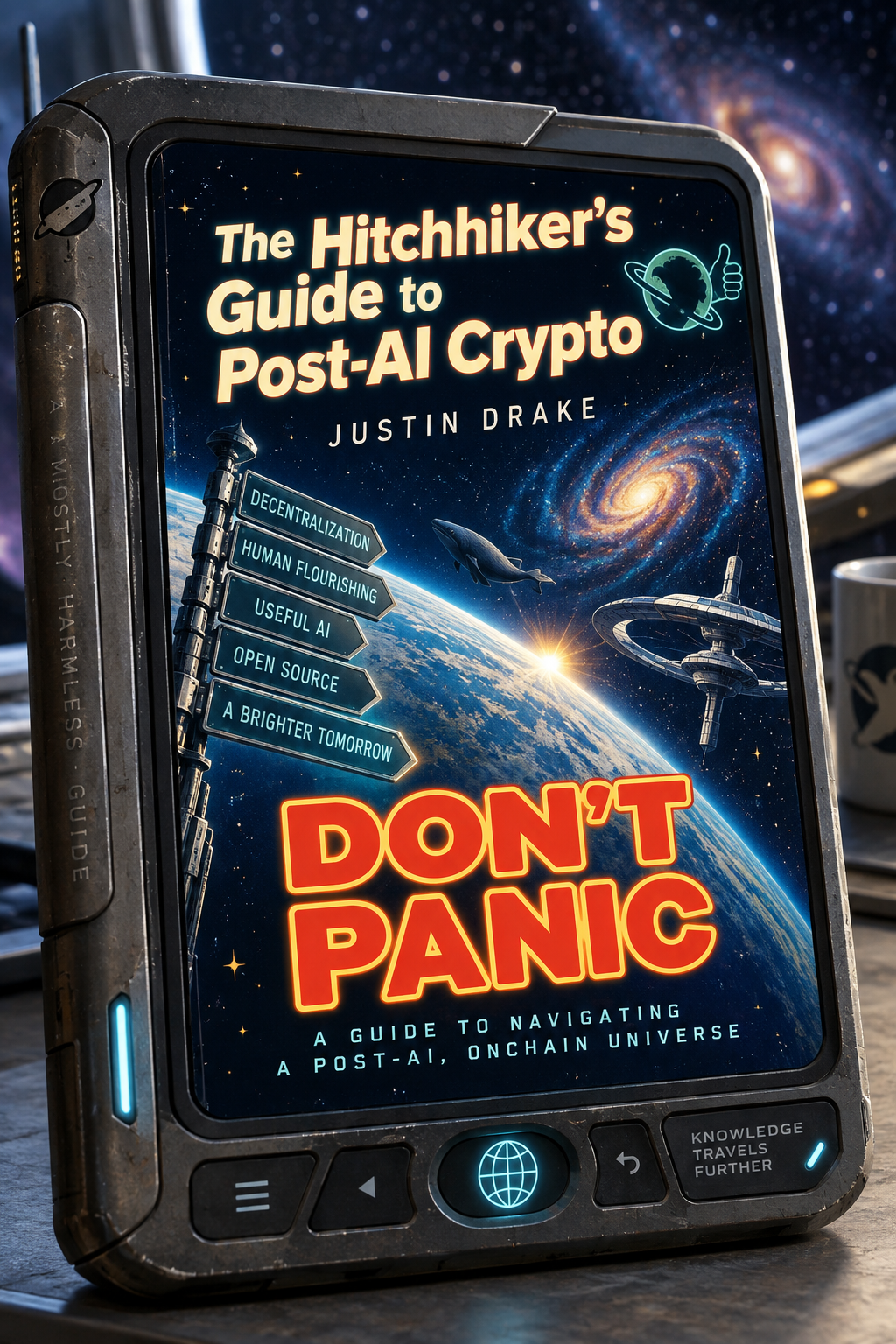
—Brady Dale
October 7, 2026
Versions · current v1 · 2026-10-07
- Version 1 · frozen pin — 2026-10-07 Imported from 81.html