The mad scientist ruse: BrainFi Gets in Your Head
BrainFi Gets in Your Head
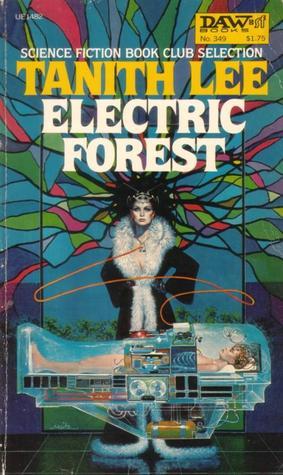
Content warning: If you've been fighting off the physical attractiveness blackpill, stay away from this book.
For a while, Tanith Lee's novel Electric Forest (1979) sounded as tho it were headed in something of a Story of O kind of direction, and honestly that's the part where the book is at its most grounded and most compelling. I read the Story of O because Stoya did a book club in Brooklyn years ago and I went. And I dutifully read the book beforehand.
It's not for everyone!
The concepts in Electric Forest are incredible. I don't think someone would have written this book after the internet. It's just not something that someone would come up with. When technology advances a certain way, when we no longer speculate about "what would happen if" because we actually know what would happen, it forecloses certain stories.
Spoiler alert: (but for a very early part of the book) The core technology that drives the plot The Electric Forest is consciousness transfer. A body can be put on life support and its consiousness can be transplanted into a simulated body that lacks consciousness. Then the person who that consciousness belongs to will experience life through that new body.
However, the trick is, it needs its body in life support to stay alive. That's where the actual experiences are really happening. The experiences of the simulated body are being sent back to that body. It's basically in a lucid dream state, except in the real world.
- (after the internet, I feel like people think about consciousness as something that can be copied, like a file, like data — in fact I think that's how John Scalzi presents consciousness transfer in this book Old Man's War — which I had to quit reading, but I suppose should be counted as BrainFi)
Lee had a fixation on the idea of moving consciousness around.
Tanith Lee (1947–2015) was a British writer whose work ranged across science fiction, fantasy, and horror. She wrote more than 70 novels and almost 300 short stories, along with radio plays and scripts for Blake's 7. Her breakthrough came with The Birthgrave in 1975, launching a prolific career in stories of strange worlds and transformation.
In fact, prior to writing Forest she authored a pair of books about a civilization called FOUR-Bee where people trade bodies like we trade-in cars. Actually, much more often than we trade-in cars! I like thinking about this kind of thing, though it is unsettling. What does identity mean if you change bodies? Are you still the same person?
It would undoubtedly change how you approach the world and your experience of the world. But from your own perspective, if you got a better deal, would you care?
The Electric Forest is bogged down by too much exposition. In fact, the biggest plot turn of the whole book takes place entirely in exposition in a way that feels like a cheat.
The book really only has a couple characters, and they are basically the same person. Everyone pretty much talks the same. They are not convincingly differentiated. And the backdrop of the world never quite came clear to me.
It doesn't live up to its potential as a novel, but as an entry in the canon of BrainFi it is exquisite. And its sensibility is just so different from a lot of science fiction. The motivations are lust, loneliness and pride more than ambition and curiosity. It just operates at a whole different beat.
I wish Lee had taken some more time to make the twists of the books reveal themselves rather than explaining them in long speeches and memos, but I feel confident saying that I will be comparing the conceptualization of consciousness in this book to that I see in other books for years. The Electric Forest deserves a wider audience than it has had so far.
Nevertheless.
Come for the honest depiction of the independence of lust and love. Stay for the wild implications of an approach to medicine that just routes around bodies.
—Brady Dale
October 16, 2026
Versions · current v2 · 2026-10-17
- Version 1 · frozen pin — 2026-10-16 Imported from 97.html
Next BrainFi: It's so easy to switch: BrainFi Gets in Your Head